Pool chemicals are not complicated once you understand them. But they are unforgiving when you get them wrong. A small mistake with chlorine, acid, or stabilizer can cloud your water, eat away at your pool surfaces, corrode your equipment, or create conditions that are genuinely unsafe to swim in.
The frustrating part is that the same five mistakes come up over and over again. Pool service technicians in Brevard County see them constantly, both in pools that homeowners maintain themselves and in pools that were previously serviced by companies cutting corners.
Here are the five chemical errors that cause the most damage, why they happen, and how to avoid them.
Mistake 1: Adding Chemicals Without Testing First
This is the most common mistake and the one that causes the most downstream problems. It happens when a pool owner adds chemicals based on a schedule or a guess rather than based on actual test results.
The logic usually goes something like this: “I add two gallons of chlorine every week, and that has always worked.” The problem is that your pool’s chemical demand changes constantly. A week with heavy rain, a pool party with ten swimmers, or a stretch of 95-degree days in July will change how fast your pool consumes chlorine. What worked last Tuesday might be too much or too little this Tuesday.
Adding chlorine without testing can result in over-chlorination, which bleaches swimsuits, irritates skin and eyes, and damages vinyl liners and plaster over time. It can also result in under-chlorination, which allows bacteria and algae to grow in water that looks deceptively clear.
The same principle applies to acid. Adding muriatic acid without first checking pH can push your water into a dangerously low pH range (below 7.0), which corrodes metal fittings, damages plaster, and makes the water uncomfortable to swim in. Not adding enough acid leaves your pH too high (above 7.8), which makes chlorine less effective and promotes calcium scale buildup.
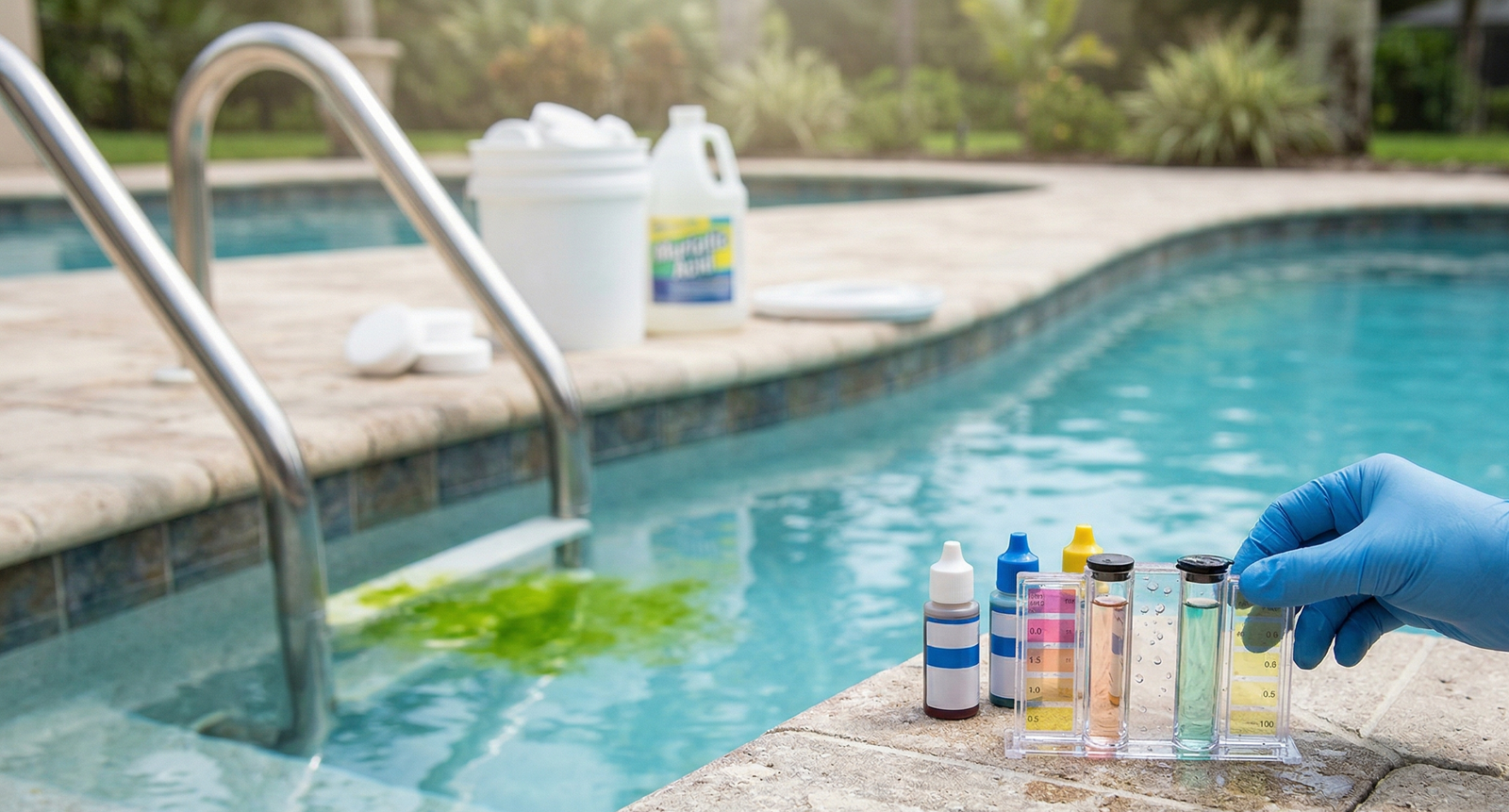
The fix: Test your water before adding anything. Every time. A quality reagent test kit (like the Taylor K-2006) costs $30 to $50 and gives accurate readings for chlorine, pH, alkalinity, and cyanuric acid. Test strips are better than nothing, but reagent tests are more reliable for the measurements that matter most.
If you use a weekly pool service, your technician should be testing your water at every visit and adjusting chemicals based on those results. If your tech is dumping chemicals without pulling out a test kit, that is one of the warning signs covered in our post about pool service companies that skip steps.
Mistake 2: Letting Cyanuric Acid Build Up Too High
Cyanuric acid (CYA), also called stabilizer or conditioner, is one of the most misunderstood pool chemicals. It protects chlorine from being destroyed by UV sunlight. Without it, direct Florida sunshine would burn through your chlorine in a matter of hours. With the right amount, chlorine lasts much longer in the water.
The recommended CYA level for most pools is 30 to 50 parts per million (ppm). At that range, your chlorine is protected from sunlight but still effective at killing bacteria and algae.
The problem is that CYA accumulates over time and does not break down easily. Every time you add stabilized chlorine tablets (trichlor), you are adding more CYA to the water. Over months and years, the level can creep up to 80, 100, 150 ppm or higher.
Here is what most pool owners do not realize: as CYA levels rise, chlorine becomes progressively less effective. At 100 ppm CYA, you need roughly three times as much free chlorine to achieve the same sanitizing power as you would at 30 ppm CYA. At 150 ppm, chlorine is nearly useless even if the test kit shows a “normal” reading.
This is why some pools have a persistent algae problem despite showing adequate chlorine levels on a test strip. The chlorine is there, but the high CYA is essentially locking it up so it cannot do its job.
How it happens: Pool owners or service companies use stabilized chlorine tablets as the sole chlorine source, week after week, month after month. Each tablet adds more CYA. Nobody tests the CYA level. After a year or two, the CYA is through the roof and the pool starts having recurring algae and clarity issues despite seemingly normal chlorine readings.
The fix: Test CYA at least once per month. If the level climbs above 70 to 80 ppm, the most effective solution is to drain a portion of the pool water and refill with fresh water that has zero CYA. There is no chemical that removes CYA from water. Dilution is the only reliable method.
To prevent CYA buildup in the first place, use liquid chlorine (sodium hypochlorite) as your primary sanitizer instead of stabilized tablets. Liquid chlorine adds zero CYA to the water. Use stabilized tablets only when you need to maintain CYA levels, not as your everyday chlorine source.
Mistake 3: Shocking the Pool During the Day
Pool shock (a large dose of chlorine or non-chlorine oxidizer) is one of the most common chemical treatments. It is used to kill algae, break down organic contaminants, and reset chlorine levels after a heavy swim load or a rainstorm.
Many pool owners add shock in the morning or afternoon, thinking it will work throughout the day. This is a waste of money and chemicals.
Chlorine-based shock (calcium hypochlorite or liquid chlorine at shock levels) is highly susceptible to UV degradation. When you add it to your pool while the sun is out, UV light starts breaking it down immediately. Depending on the intensity of the sunlight and whether your CYA level is adequate, you can lose 50% or more of the shock dosage to UV burn-off before it has a chance to do its job.
In Brevard County, where sunshine is intense for most of the year, daytime shocking is especially wasteful. The UV index on a typical summer afternoon on the Space Coast is 10 to 11 on a scale of 11. That is about as intense as it gets anywhere in the continental United States.
The fix: Always shock your pool after sunset. Adding shock in the evening gives the chlorine 8 to 10 hours of darkness to work at full strength before the sun comes up. By morning, the shock has done its job and your chlorine level will have dropped back into the normal swimming range.
Run your pump overnight after shocking so the treated water circulates through the entire pool and filter system.
Mistake 4: Ignoring Alkalinity and Only Watching pH
Most pool owners know they need to keep an eye on pH. It is the number everyone talks about, and it is the first test on most kits and strips. The ideal pH range for pool water is 7.4 to 7.6.
What many pool owners do not understand is that alkalinity controls pH. Total alkalinity (TA) acts as a buffer that keeps pH stable. When alkalinity is in the right range (80 to 120 ppm), pH stays relatively steady between service visits. When alkalinity is too low, pH swings wildly and becomes very difficult to control.
Here is the pattern that plays out in pools with low alkalinity. The pool owner adds acid to bring pH down. The pH drops quickly because there is no buffer to resist the change. A day later, the pH has bounced back up because the underlying alkalinity issue was never addressed. The owner adds more acid. The pH drops again and bounces back again. This cycle repeats, and every round of unnecessary acid addition damages the pool surfaces and corrodes metal components.
The reverse problem is also common. High alkalinity (above 150 ppm) makes pH resist changes. The pool owner adds acid and nothing seems to happen. So they add more. And more. Eventually the acid overwhelms the buffer and pH crashes to a dangerously low level.
The fix: Always test and adjust alkalinity before adjusting pH. If alkalinity is within range, pH adjustments will be smaller, more predictable, and more stable. If alkalinity is out of range, fix that first.
To raise alkalinity, add sodium bicarbonate (baking soda). To lower alkalinity, add muriatic acid in small doses with the pump running, ideally near a return jet so the acid disperses quickly.
A good pool cleaning service tests alkalinity at every visit and keeps it in range so that pH stays stable between visits. If your pool’s pH is constantly swinging high or low despite regular acid additions, the problem is almost certainly alkalinity, not pH.
Mistake 5: Mixing or Storing Chemicals Improperly
This mistake is less about water chemistry and more about personal safety, but it needs to be on this list because the consequences can be severe.
Pool chemicals are industrial-strength products. Liquid chlorine is a strong oxidizer. Muriatic acid is hydrochloric acid. Calcium hypochlorite (granular shock) is a powerful oxidizer that reacts violently with moisture, organic material, and other chemicals. Trichlor tablets release toxic chlorine gas if they get wet outside the feeder or contact other chemicals.
The most dangerous scenario is mixing chlorine and acid. When liquid chlorine and muriatic acid come into contact, they produce chlorine gas, which is toxic and can be fatal in enclosed spaces. This can happen if you store the two chemicals next to each other and one container leaks, or if you add acid to the pool immediately after adding chlorine without giving it time to disperse.
Other dangerous combinations include mixing granular shock (calcium hypochlorite) with trichlor tablets, which can cause a fire or explosion. Adding water to granular shock instead of adding shock to water, which can cause a violent exothermic reaction. And using a container that previously held one chemical to measure or store a different chemical.
Storage rules that matter: Store chlorine products and acid products in separate locations, never on the same shelf or in the same cabinet. Keep all chemicals in their original containers with labels intact. Store chemicals in a cool, dry, ventilated area away from direct sunlight. Never store chemicals in an enclosed space like a sealed shed or closet without ventilation. Keep chemicals away from children, pets, and anything flammable.
Handling rules that matter: Always add chemicals to water, never water to chemicals. Wear gloves and eye protection when handling liquid chlorine and muriatic acid. Never mix different chemicals together. Wait at least 15 to 20 minutes between adding different chemicals to your pool so each one disperses before the next is added. If you spill a chemical, clean it up immediately with plenty of water and ventilate the area.
The fix for most homeowners: Let a professional handle the chemicals. One of the underrated benefits of a weekly pool service is that you do not have to buy, store, transport, or handle pool chemicals at all. Your technician brings what is needed, uses it properly, and takes the unused portion with them.
The Common Thread
All five of these mistakes share a root cause: either a lack of testing, a lack of knowledge, or a lack of consistency. Pool chemistry is not hard, but it requires attention every week. In Florida’s climate, where heat, rain, and UV exposure constantly push your water chemistry out of balance, you cannot set it and forget it.
The good news is that avoiding these mistakes is straightforward. Test before you treat. Watch your CYA. Shock at night. Manage alkalinity first. Handle chemicals safely. Do those five things consistently and your pool water will be healthier, your surfaces will last longer, and your equipment will run better for years.
If you would rather have a professional handle all of this for you, reach out to Happy Pool and Spa for a free quote. Our technicians test and balance water chemistry at every visit using professional-grade test kits. We serve pool owners across all of Brevard County, from Palm Bay to Indialantic and everywhere in between.