Every pool owner has thought about it. Maybe the budget is tight for a month. Maybe you are going on vacation. Maybe you figure the pool can coast for a few weeks without professional service and you will deal with it when you get back.
In most parts of the country, skipping a month of pool service might not be a disaster. In Florida, it is a different story. The combination of year-round heat, intense UV exposure, daily humidity, frequent rain, and a biological environment that wants to grow things in your water makes Florida one of the worst places to neglect a pool, even briefly.
Here is what actually happens to an unserviced pool in Brevard County over 30 days, laid out day by day. This timeline assumes a pool that was in good condition on day one with proper chemical balance and clean equipment, and then received no service, no chemical treatment, and no physical maintenance for an entire month.
Days 1 Through 3: Everything Looks Fine
For the first few days, your pool looks normal. The water is still clear. The chemical levels are still in range, though they are starting to decline. The pump is running on its timer and the filter is doing its job.
Chlorine is being consumed by UV sunlight, organic matter, and the natural demand of the water. In Brevard County’s summer sun, unprotected chlorine can lose 1 to 2 ppm per day. If your pool started at 4 ppm, it could be down to 1 to 2 ppm by day three.
The skimmer basket is collecting some debris but it is not full yet. A few leaves and bugs, nothing alarming.
At this stage, you would look at the pool and think skipping service was no big deal. That feeling does not last.
Estimated recovery cost at this point: $0 to $50. A quick chemical adjustment gets everything back on track.
Days 4 Through 7: Chemistry Starts to Slide
By the end of the first week, chemical levels have shifted noticeably. Free chlorine is approaching or has dropped below 1 ppm, which is the minimum effective level for sanitization. pH has likely drifted upward (a natural tendency in most pools) or been pushed around by rain if there was an afternoon storm.
With chlorine below effective levels, bacteria and algae spores in the water are no longer being killed. They are not visible yet, but they are alive and starting to reproduce. Algae spore populations can double every 3 to 6 hours under ideal conditions, and Brevard County’s warm water temperatures provide exactly those conditions.
The skimmer basket is getting fuller. Leaves, pollen, and insects are accumulating. If the basket fills up, it restricts water flow to the pump. The pump has to work harder, which increases energy consumption and accelerates wear on the motor.
You might notice the water looks slightly less vibrant than usual. Not green, not cloudy, just not quite as crisp and blue as it normally is. Most pool owners would not think twice about it.
Estimated recovery cost at this point: $50 to $100. A shock treatment and chemical rebalance with a filter cleaning handles it.
Days 8 Through 10: The First Visible Signs
This is when the problems become visible. A faint green tint appears in the water, especially noticeable when you look at the pool from a low angle or when sunlight hits it at certain times of day. The walls may feel slightly slippery in spots, particularly in shaded areas and corners where algae likes to establish first.
Free chlorine is essentially gone. The water is now an uncontrolled biological environment. Algae is growing on every surface. Bacteria populations are climbing. If anyone swam in this water, they would be at risk for skin infections, eye infections, and gastrointestinal illness.
The skimmer basket is likely full or overflowing. Debris that the skimmer cannot catch is sinking to the pool floor and decomposing. Decomposing organic matter consumes any remaining oxygen in the water and creates additional nutrient load that feeds algae growth.
Filter pressure is climbing because the filter is trapping algae and organic particles without being cleaned. Flow rate through the system is decreasing.
Estimated recovery cost at this point: $100 to $250. This requires a professional cleaning visit with heavy shock treatment, thorough brushing, filter cleaning, and chemical rebalancing. A single visit can usually resolve a day-10 pool.
Days 11 Through 14: Solidly Green
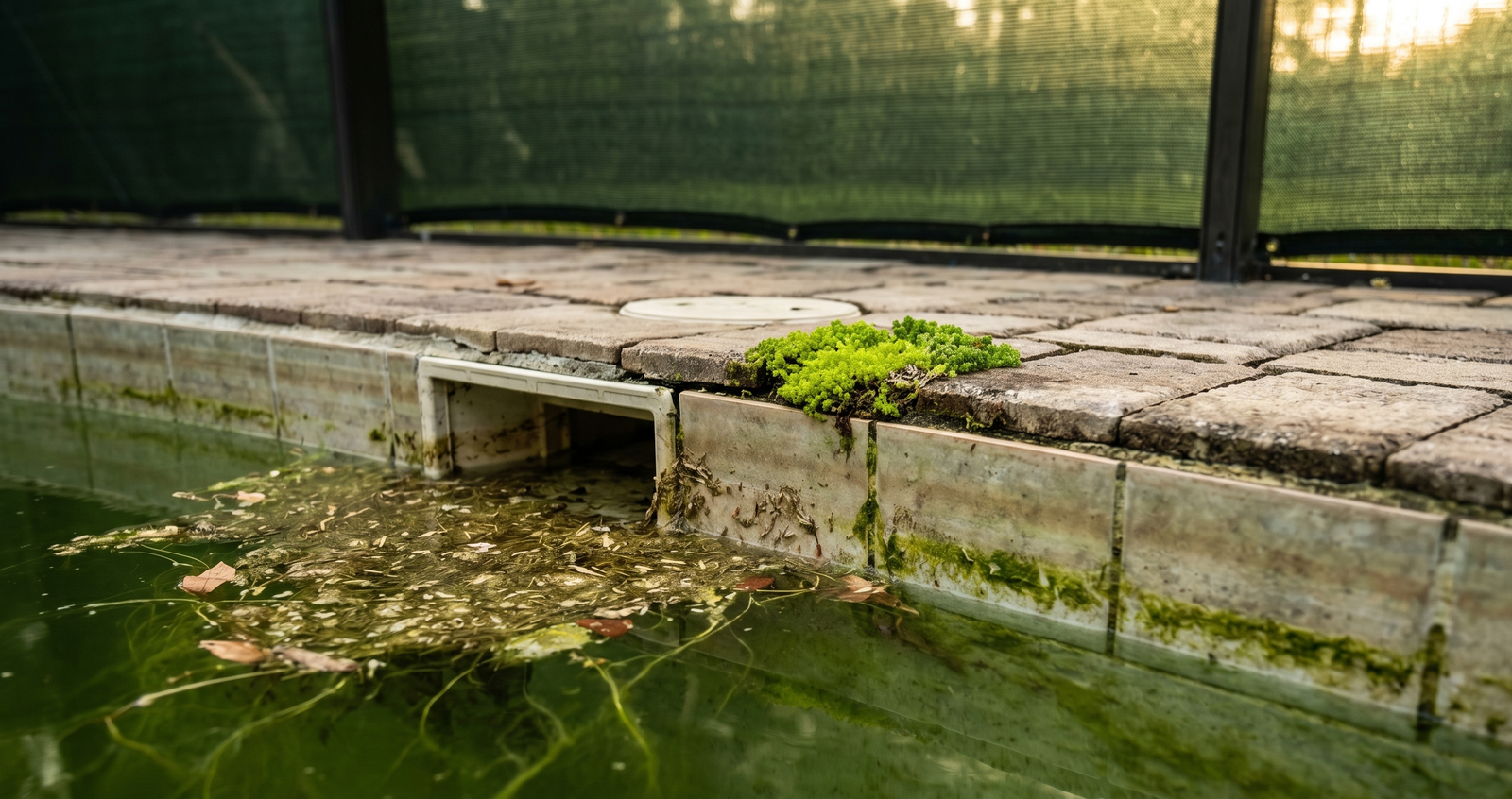
By the end of the second week, the pool is undeniably green. The water has gone from a faint tint to a solid green color. You can still see the bottom in the shallow end, but the deep end is murky. The walls and floor are coated with algae.
The filter is under heavy stress. It is clogged with algae and debris and is no longer filtering effectively. Water clarity is declining rapidly because the filter cannot keep up. If the filter is a cartridge type, the cartridge may be permanently stained green at this point and could need replacement rather than just cleaning.
The pump is working harder than normal because of the restricted flow from the clogged filter and full skimmer basket. Motor temperature is elevated. If this continues for much longer, the motor bearings will start to wear prematurely.
Mosquitoes have discovered the stagnant, debris-laden water. In Brevard County, standing water is a breeding ground for mosquitoes year-round. A neglected pool can produce thousands of mosquitoes per week, which is not just a nuisance but a genuine health concern given the presence of mosquito-borne diseases in Florida.
The pool deck may have algae starting to grow on it as well, particularly in shaded areas and along the edge where pool water splashes. Algae on the deck creates a slip hazard.
Estimated recovery cost at this point: $250 to $500. This is now a multi-visit green-to-clean job. It requires heavy shocking, multiple rounds of brushing, filter cleaning (potentially multiple cleanings), and several days of continuous pump operation. Chemical costs alone will be $50 to $100.
Days 15 Through 21: The Tipping Point
The third week is when secondary problems start stacking on top of the algae. The pool is now dark green. Visibility is measured in inches, not feet. You cannot see the bottom anywhere.
Debris on the pool floor has formed a layer of decomposing organic sludge. This sludge releases phosphates and nitrogen into the water, which further accelerates algae growth. It is a feedback loop: more debris creates more nutrients, which creates more algae, which creates more debris when it dies and sinks.
Water chemistry is in free fall. pH may have swung to extreme levels in either direction. Alkalinity is unstable. Calcium hardness may be climbing as evaporation concentrates minerals in the water. These chemical imbalances are actively damaging your pool surfaces.
Plaster surfaces exposed to low pH water are being etched. The acid eats away at the calcium in the plaster, creating a rough, pitted texture that is permanently damaged. This process is invisible under the green water, but you will see the damage when the pool is eventually cleaned.
If the pool has a salt chlorine generator, the salt cell is scaling up rapidly because nobody is checking or cleaning it. Heavy scale buildup shortens the cell’s life and can permanently damage the plates.
Equipment is under significant stress. The pump motor is overheating regularly. The filter is essentially non-functional. If the heater has been running (some are on automatic schedules), it may have tripped a safety switch or suffered damage from operating with insufficient water flow.
Estimated recovery cost at this point: $400 to $800. Multiple service visits over 5 to 10 days. Heavy chemical load. Filter cartridge or media may need replacement. Equipment inspection and potential minor repairs.
Days 22 Through 30: Full Neglect
By the end of the month, the pool has crossed from “neglected” into “abandoned” territory. The water is dark green to black. There may be visible organic growth on the surface. Insects are breeding. The smell of stagnant, anaerobic water may be noticeable from a distance.
The pump may have failed. A month of running against a clogged filter with elevated motor temperatures is enough to burn out motor bearings or trip thermal overloads. If the pump has stopped running, the water is completely stagnant, which accelerates every problem.
The filter is destroyed in practical terms. Cartridge elements are stained and clogged beyond cleaning. Sand or DE media is contaminated. The filter likely needs new media or a full cartridge replacement.
Pool surfaces have taken real damage. Plaster etching from chemical imbalance is permanent. Algae staining on the plaster may be permanent depending on the type of algae and how long it was present. Tile may have calcium scale or organic staining that requires acid washing to remove.
The screen enclosure, if present, may have algae growing on the frames and screen material. Algae on screens reduces light transmission and accelerates deterioration of the screen fabric.
If the property has an HOA, you may be receiving violation notices for the visible condition of the pool area. If the property is a rental, tenants may be withholding rent or filing complaints.
Estimated recovery cost at this point: $600 to $1,500 or more. This is a full green-to-clean operation that may take 1 to 3 weeks. It may require partial draining and acid washing of the pool surface ($400 to $800 additional). Equipment repairs or replacements could add $300 to $2,000 depending on what failed. Filter media or cartridge replacement adds $100 to $400.
The Math That Tells the Full Story
Here is the comparison that puts it all in perspective.
One month of professional weekly pool service in Brevard County costs $80 to $150, or roughly $320 to $600 total for the month.
Recovering a pool that was neglected for that same month costs $600 to $1,500 in professional cleaning fees, plus potential equipment repairs of $300 to $2,000, plus potential surface damage that will not show up until the pool is clean (plaster etching, staining) that could cost $1,000 to $5,000 to repair down the road.
Skipping one month of service to save $320 to $600 can easily result in $1,000 to $3,000 in recovery costs. In a worst case scenario with equipment failure and surface damage, the total bill can exceed $5,000.
The savings from skipping service are not savings at all. They are deferred costs with interest.
What to Do If You Will Be Away
If you are traveling or otherwise unable to monitor your pool for an extended period, the worst thing you can do is cancel your service. Your pool needs consistent maintenance more when you are away, not less, because nobody is there to notice early warning signs.
Keep your regular pool cleaning service running the entire time you are gone. If anything, consider upgrading to twice-weekly service during summer months when you are traveling. The extra visit provides a mid-week chemistry check that catches problems before they snowball.
Give your pool service company a way to contact you while you are away. If they find an issue that needs attention (a broken pipe, a failed pump, a screen enclosure damaged by a storm), you want to know about it while it is still a small problem rather than coming home to a disaster.
If budget is the reason you are considering pausing service, talk to your pool company about a reduced-frequency plan rather than stopping entirely. Even biweekly service, while not ideal in Florida, is dramatically better than no service. Chemical checks every two weeks can prevent the worst outcomes even if the pool does not look its absolute best between visits.
The Florida Factor
This timeline would play out differently in a cooler climate. In states where pool water stays in the 60s or 70s, algae grows slowly and a month without service might result in mild cloudiness rather than a full-blown swamp.
In Brevard County, where pool water temperatures reach the mid-80s to low 90s for five months of the year, every biological process runs at maximum speed. Algae reproduces faster. Bacteria multiplies faster. Chemical demand is higher. Organic decomposition is quicker. The margin for error is essentially zero during Florida’s summer.
Even during the cooler months from December through February, Brevard County pools still need consistent care. Water temperatures in the 60s and 70s are still warm enough for algae growth, especially after a warm spell or a rain event. Pools in Florida never truly go dormant the way they do in northern states.
The Real Cost of Pool Service
When you see your monthly pool service bill, do not think of it as an expense. Think of it as the cost of preventing the alternative. One month of consistent service prevents one month of deterioration that would cost several times more to fix.
The pool owners who spend the least money on their pools over time are not the ones who skip service. They are the ones who never miss a week.
If you want reliable weekly service that keeps your pool in perfect condition whether you are home or away, contact Happy Pool and Spa for a free quote. We serve every community in Brevard County, from Melbourne to Palm Bay to Satellite Beach to Cocoa Beach and everywhere in between.