
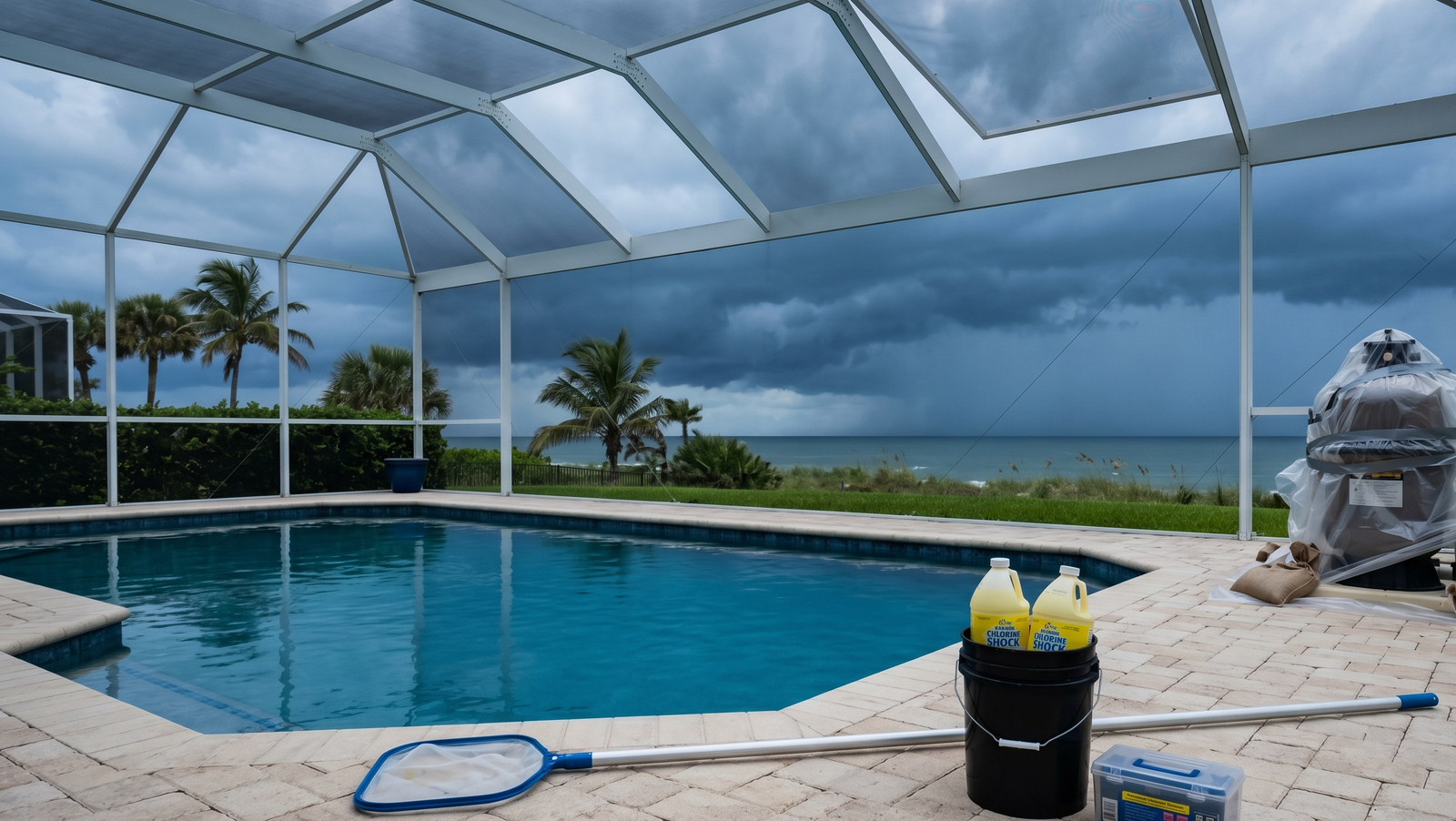
Hurricane season runs from June 1 through November 30 every year. For pool owners on the Space Coast, that is six months of potential storms that can damage equipment, contaminate water, and turn a clean pool into an expensive recovery project.
Brevard County sits directly on Florida’s Atlantic coast, which puts it in the path of hurricanes more often than most inland areas. The county has been impacted by multiple hurricanes and tropical storms over the past two decades, and every storm season carries the risk of a direct hit or a close pass that brings damaging winds and flooding rain.
The good news is that pool damage from hurricanes is largely preventable with proper preparation. The bad news is that most pool owners either do nothing or do the wrong things. This checklist covers exactly what to do before, during, and after a hurricane, with the actual costs for each step so you can budget accordingly.
What NOT to Do (Common Myths)
Before getting into the checklist, let’s clear up a few hurricane pool myths that persist despite being wrong.
Do not drain your pool. This is the most dangerous myth. Many pool owners think they should empty their pool before a hurricane to prevent overflow. The opposite is true. An empty or partially drained pool is at serious risk of “popping” out of the ground. When heavy rain saturates the soil around an empty pool, the hydrostatic pressure of the groundwater can push the pool shell upward, cracking it and potentially lifting it out of the ground entirely. This is a catastrophic, five-figure repair. Keep your pool full. The weight of the water holds the pool in place.
Do not throw your patio furniture in the pool. This old recommendation has been floating around for decades and it needs to stop. The idea is that submerging furniture prevents it from becoming a projectile in high winds. The problem is that metal furniture scratches and stains your pool plaster, cushions clog your drain and skimmer, and furniture legs can crack tile and damage the pool finish. The cost of plaster repair from furniture damage can easily exceed the cost of the furniture itself. Instead, move furniture into your garage, storage shed, or inside your home.
Do not turn off your pump before the storm and leave it off. Your pump should be turned off before the storm hits (to prevent electrical damage from power surges and to avoid running it while debris is in the water), but it should be turned back on as soon as possible after the storm passes. Leaving the pump off for days after the storm allows water chemistry to deteriorate rapidly and gives algae a window to take hold.
Pre-Storm Checklist (48 to 72 Hours Before)
This is the work that matters most. Everything on this list should be done 2 to 3 days before the storm is expected to arrive. Do not wait until the day before. If you wait too long, pool supply stores will be sold out and service companies will be fully booked.
Balance Your Water Chemistry
What to do: Test your water and make sure all chemistry parameters are within range. Pay special attention to chlorine and pH. Bring free chlorine up to the high end of the safe range (4 to 5 ppm) so it has a buffer to absorb the dilution from heavy rain. Make sure pH is at 7.4 to 7.6 and alkalinity is at 80 to 120 ppm.
Why it matters: A hurricane can dump 5 to 15 inches of rain on Brevard County. That much fresh water will significantly dilute your chlorine, crash your pH, and reduce your alkalinity. Starting with strong chemistry gives your pool the best chance of staying clear through the storm.
Cost: $0 to $50 if you have chemicals on hand. $30 to $80 if you need to buy chlorine, acid, and test supplies.
Super-Chlorinate (Shock) Your Pool
What to do: Add a heavy dose of liquid chlorine to bring your free chlorine level up to 10 to 15 ppm. This is well above normal swimming levels, but you are not going to be swimming during a hurricane. The elevated chlorine gives your pool a large reserve to absorb the storm’s impact.
Why it matters: The combination of rain dilution, organic debris from the storm, and potential days without pump circulation will consume chlorine rapidly. Starting at 10 to 15 ppm means your chlorine may still be at a functional level (above 1 ppm) by the time you can get the pump running again after the storm.
Cost: $15 to $40 in liquid chlorine (2 to 4 gallons depending on pool size).
Remove Loose Items From the Pool Area
What to do: Take everything out of the pool area that is not permanently attached. This includes patio furniture, umbrellas, pool floats, toys, skimmer lids that are not screwed down, chemical feeders (remove floating chlorinators from the water), decorative items, potted plants, and any loose screen panels.
Why it matters: In hurricane-force winds, every loose object is a projectile. A flying patio chair can shatter a sliding glass door, puncture a screen enclosure, or crack pool tile. Removing these items protects your pool and your home.
Cost: $0 (just labor and time).
Secure Your Screen Enclosure
What to do: If your screen enclosure has panels that are already loose, damaged, or improperly fastened, have them repaired or removed before the storm. Some pool owners proactively remove a few screen panels to allow wind to pass through the structure rather than catching against the screen like a sail.
Why it matters: Screen enclosures are not designed to withstand hurricane-force winds. A fully screened enclosure can act as a wind barrier that puts enormous stress on the frame, potentially collapsing the entire structure. Removing a few panels (especially on the windward side) reduces wind load and may save the frame even if you lose some screens.
Cost: $0 to remove panels yourself. $100 to $300 for a screen repair company to handle it.
Trim Overhanging Trees and Vegetation
What to do: Cut back any tree branches, palm fronds, or vegetation that hangs over or near the pool. Remove dead branches and loose fronds that could break off in high winds.
Why it matters: Falling branches are one of the biggest sources of pool damage during hurricanes. A large branch can crack pool decking, damage the screen enclosure, break pool equipment, and deposit a massive amount of organic debris into the water. Trimming before the storm reduces this risk significantly.
Cost: $0 to $100 if you do it yourself. $150 to $500 for a tree service, depending on the scope of work.
Protect Your Pool Equipment
What to do: Turn off the circuit breaker for your pool pump, heater, and any other pool equipment. If you have a variable-speed pump with electronic controls, consider wrapping the control panel in plastic sheeting to protect it from wind-driven rain. Remove the pump lid and store it inside so it does not blow away. If your equipment is in a low-lying area that could flood, consider sandbagging around the equipment pad.
Do not disconnect plumbing. Leave all pipes and fittings connected. Disconnecting plumbing creates openings where debris and floodwater can enter the system.
Why it matters: Power surges during and after hurricanes can fry pump motors, control boards, and heater electronics. Turning off the breaker eliminates this risk. Water intrusion into electronic components causes corrosion and short circuits. Wrapping or covering electronics provides an extra layer of protection.
Cost: $0 to $20 for plastic sheeting and tape. Sandbags: $5 to $30 depending on quantity.
Lower Your Water Level Slightly
What to do: Lower your pool water level by 1 to 2 feet below the normal operating level. This is a judgment call based on the expected rainfall. For a tropical storm with moderate rain, lowering by 6 to 12 inches may be sufficient. For a major hurricane with expected rainfall of 10 inches or more, lowering by 1 to 2 feet gives the pool room to absorb the rain without overflowing.
Why it matters: An overflowing pool sends untreated, chemically-treated water across your yard, deck, and potentially into your home. It can also flood the equipment pad and submerge pumps and heaters. Lowering the water level gives the pool capacity to hold the incoming rainwater.
Cost: $0 (use your pump or a submersible pump to lower the level, or use the drain spigot on your filter).
Stock Up on Post-Storm Supplies
What to do: Buy everything you will need for post-storm recovery before the storm hits. This includes liquid chlorine (at least 4 to 6 gallons), muriatic acid (1 to 2 gallons), a leaf net or heavy-duty skimmer net, trash bags for debris, replacement skimmer baskets if yours are old, and a backup test kit.
Why it matters: After a hurricane, pool supply stores are overwhelmed. Liquid chlorine sells out within hours. If you do not have supplies on hand, you may wait days or weeks to begin pool recovery, during which time the water turns into a swamp.
Cost: $50 to $120 for a full post-storm supply kit.
During the Storm
Once the storm is underway, there is nothing to do with your pool. Stay inside. Stay safe. Your pool will be there when the storm passes.
Do not go outside to check on the pool during the storm. Do not try to skim debris while it is raining. Do not turn equipment on during the storm. Pool recovery starts after the storm ends and conditions are safe.
Post-Storm Checklist (As Soon as Conditions Are Safe)
After the storm passes and conditions are safe to go outside, start the recovery process as soon as possible. Every hour of delay allows the water to deteriorate further.
Safety First
What to do: Before touching anything, survey the pool area for hazards. Look for downed power lines (do not approach, call FPL), structural damage to the screen enclosure (unstable frames can collapse), cracked or raised deck sections (trip hazards), standing water around the equipment pad, and debris in the pool that could conceal sharp objects.
If there is a downed power line anywhere near the pool or equipment, do not enter the area. Call 911 and your power company immediately.
Cost: $0.
Remove Debris
What to do: Use a leaf net or large skimmer net to remove as much debris from the pool surface and floor as possible. Do this by hand before turning on the pump. Running the pump with heavy debris in the pool can clog the skimmer, jam the impeller, and damage the filter.
Remove large branches, leaves, palm fronds, and any foreign objects. If there is a thick layer of debris on the pool floor, use a leaf rake (not a standard skimmer) to scoop it out.
Cost: $0 if you have a leaf net. $15 to $40 for a new leaf net if yours was damaged.
Inspect Equipment Before Powering On
What to do: Before turning the breaker back on, visually inspect all equipment. Check the pump housing for cracks. Look for broken or disconnected pipes. Check the filter tank for damage. Look at the heater for signs of flooding or impact damage. Check all electrical connections for water intrusion, corrosion, or visible damage.
If everything looks intact, turn the breaker on and start the pump. Listen for unusual noises. Watch for leaks. Check that water is flowing normally through the system.
Cost: $0 for the inspection. If equipment is damaged, repair costs vary: pump motor replacement ($300 to $800), filter repair ($100 to $400), heater repair ($200 to $1,000), plumbing repair ($100 to $500).
Shock the Pool
What to do: Once the pump is running and debris has been removed, add a heavy shock dose of liquid chlorine. Bring the free chlorine level up to 15 to 20 ppm. The water is likely loaded with contaminants from the storm (dirt, organic matter, fertilizer runoff, possibly sewage if flooding occurred), and it needs aggressive treatment to become safe again.
Cost: $15 to $50 in liquid chlorine.
Run the Pump Continuously
What to do: Run the pump 24 hours a day until the water is clear. This may take 2 to 7 days depending on how contaminated the water is. Clean the filter every 12 to 24 hours during this period, as it will clog quickly with storm debris and dead algae.
Cost: $20 to $60 in additional electricity for continuous pump operation over several days.
Rebalance Chemistry
What to do: Once the water starts to clear, test all chemistry parameters and rebalance. Focus on chlorine, pH, alkalinity, and CYA. The storm likely disrupted all of these. Bring each one back into the ideal range gradually.
Cost: $20 to $60 in chemicals for rebalancing.
Assess and Repair Damage
What to do: Once the pool is clean and operating normally, assess any physical damage. Check the pool surface for cracks, chips, or staining. Check the deck for cracks or lifted sections. Inspect the screen enclosure for tears, bent frames, or missing panels. Document everything with photos for insurance purposes.
Cost: Varies widely. Screen repairs: $200 to $2,000. Deck repairs: $300 to $3,000. Pool surface repairs: $500 to $5,000. Equipment replacement: $300 to $5,000.
Total Pre-Storm Preparation Cost
Adding up all the preparation steps:
| Item | Cost Range |
|---|---|
| Chemicals (shock + balancing) | $45 to $120 |
| Loose item removal | $0 |
| Screen panel removal/repair | $0 to $300 |
| Tree trimming | $0 to $500 |
| Equipment protection | $0 to $30 |
| Post-storm supply kit | $50 to $120 |
| Total Preparation | $95 to $1,070 |
Most homeowners who handle the prep themselves and do not need tree service will spend $100 to $250 total. That is a fraction of what an unprepared pool costs to recover after a storm.
When to Call a Professional
If you have a weekly pool service, talk to your company before the storm about their pre-storm and post-storm protocols. Good companies will adjust your service schedule to include a pre-storm preparation visit and a post-storm recovery visit.
After the storm, if your pool is severely contaminated (black or dark green water, heavy debris, potential sewage contamination from flooding), or if your equipment is damaged and will not start, call your pool cleaning service for professional recovery rather than trying to handle it yourself. The cost of a professional post-hurricane pool cleanup typically runs $200 to $800 depending on severity, which is reasonable considering the scope of work involved.
Happy Pool and Spa serves pool owners across all of Brevard County through every hurricane season. We provide pre-storm preparation, post-storm recovery, and everything in between. If you want a pool service team that has your back when the weather gets serious, contact us for a free quote. We serve Melbourne, Palm Bay, Satellite Beach, Cocoa Beach, Rockledge, Indialantic, Viera, and every other community in the county.
Your pool can survive any hurricane that Brevard County throws at it. The difference between a quick recovery and a costly disaster comes down to preparation.