If you manage a commercial pool in Brevard County, whether it belongs to an HOA, hotel, apartment complex, gym, or water park, you are subject to Florida Department of Health inspections. These inspections are not optional, they are not scheduled at your convenience, and the consequences of failing one range from fines to forced closure.
Most property managers and HOA boards know inspections exist. Far fewer know exactly what inspectors check, what triggers a violation, and what the financial penalties actually look like. That lack of knowledge is expensive. Violations that could have been prevented with basic maintenance end up costing thousands in fines, emergency repairs, and lost pool access.
Here is everything you need to know about commercial pool compliance in Florida, written in plain language without the legal jargon.
Who Regulates Commercial Pools in Florida?
Commercial pools in Florida are regulated by the Florida Department of Health (DOH) under Chapter 64E-9 of the Florida Administrative Code. Each county has a local DOH office that handles permits, inspections, and enforcement. In Brevard County, the DOH Environmental Health division oversees all public and commercial swimming pools and spas.
The term “public pool” under Florida law is broader than most people realize. It does not just mean municipal pools open to the general public. It includes any pool that is available for use by more than one single-family household. That means HOA and community pools, hotel and motel pools, apartment and condominium pools, gym and fitness center pools, water parks and splash pads, country club pools, and rental property pools that are shared among multiple tenants.
If your pool fits any of these categories, it is classified as a public pool under Florida law and must comply with DOH regulations.
The Permit Requirement
Every commercial pool in Florida must have a valid operating permit from the DOH. This permit must be renewed annually. The permit fee varies by pool type and size, but it typically ranges from $200 to $500 per year for a standard community pool.
Operating a commercial pool without a valid permit is itself a violation that can result in fines and a mandatory closure order until the permit is obtained.
The permit must be displayed in a visible location near the pool. Inspectors check for this. If they arrive and cannot find a current permit posted, it is noted as a violation before they even look at the water.
How Inspections Work
DOH inspectors conduct both routine inspections and complaint-driven inspections.
Routine inspections happen at least once per year for most commercial pools, though many facilities are inspected two to four times per year depending on the pool type, size, and history of compliance. High-risk facilities like water parks and high-bather-load hotel pools tend to get more frequent visits.
Complaint-driven inspections are triggered when someone (usually a resident, guest, or neighbor) files a complaint with the DOH. Common complaints include unsanitary water, missing safety equipment, broken barriers or gates, and chemical odors. Once a complaint is filed, an inspector will typically visit within a few business days.
Inspectors do not call ahead. They arrive unannounced during normal operating hours. If the pool is open for use, it must be in compliance at that moment, not just on the day you knew someone was coming.
What Inspectors Actually Check
DOH inspections cover a wide range of items. Here are the categories and specific items that inspectors evaluate, roughly in the order they typically check them.
Water Chemistry
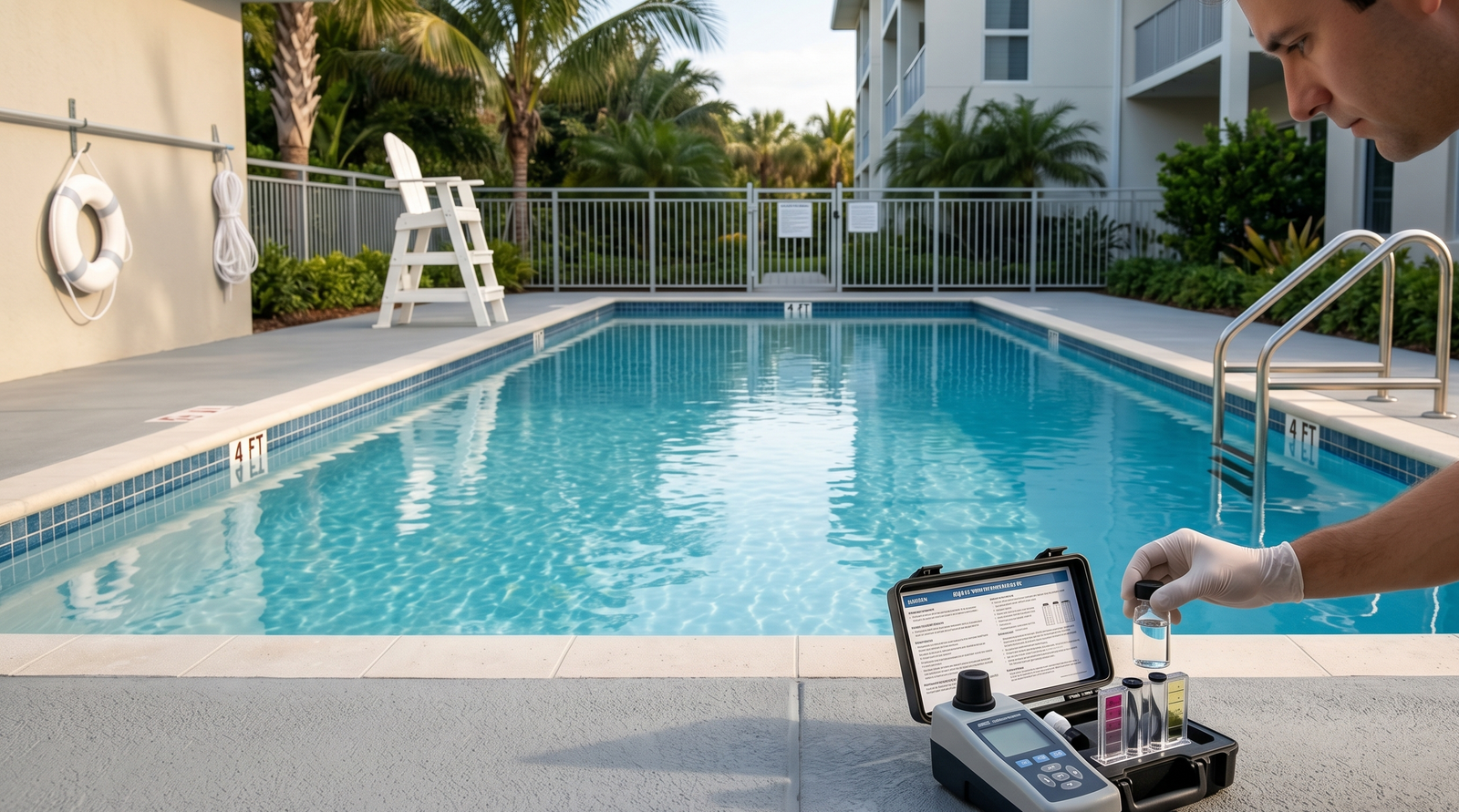
This is usually the first thing an inspector tests. They bring their own test kit and take a water sample from the pool. The parameters they check include:
Free chlorine must be between 1.0 and 10.0 ppm for chlorinated pools. The ideal range is 2.0 to 4.0 ppm. A reading below 1.0 ppm is an automatic violation because the water is not adequately sanitized. A reading above 10.0 ppm is also a violation because it creates a health risk for swimmers.
pH must be between 7.2 and 7.8. Readings outside this range are violations. Low pH (below 7.2) causes eye and skin irritation and corrodes metal components. High pH (above 7.8) reduces chlorine effectiveness and promotes scale buildup.
Cyanuric acid must not exceed 100 ppm for outdoor pools. Levels above 100 ppm reduce chlorine effectiveness to the point where the water may not be safely sanitized even if the chlorine reading appears adequate.
Water clarity must be sufficient to clearly see the main drain at the deepest point of the pool. If the drain is not visible, the pool fails. This is both a water quality issue and a safety issue, since lifeguards and bystanders cannot see a swimmer in distress if the water is cloudy.
Safety Equipment and Features
Inspectors check for all required safety equipment and features:
Drain covers must be VGB-compliant and not expired. Inspectors check the manufacture date and rated lifespan stamped on each cover. Cracked, missing, or expired covers are violations.
Pool barriers and fencing must meet height and gap requirements. Gates must be self-closing and self-latching. Latches must be positioned to prevent children from reaching them.
Depth markers must be clearly visible and accurate. They are required at specific intervals around the pool perimeter, at the shallow end, deep end, and at the point of break (where the floor transitions from shallow to deep).
No diving signs are required where the water depth is less than 5 feet. These signs must be clearly visible and in good condition.
Life-saving equipment must be present and accessible. This typically includes a reaching pole (shepherd’s crook) and a ring buoy with attached rope. The equipment must be in functional condition, not broken or missing components.
A telephone or other means of communication for emergency calls must be accessible from the pool area. A posted sign with emergency numbers (911, poison control) is also required.
First aid kit must be on-site and stocked.
Mechanical Systems
Inspectors evaluate the pool’s mechanical systems to ensure they are functioning properly:
The pump must be operational and providing adequate flow. A non-functioning pump is an immediate violation and typically results in a closure order because the water cannot be filtered or circulated.
The filter must be in working condition and maintaining adequate water clarity. Inspectors may check filter pressure readings against the manufacturer’s recommended range.
Chemical feed systems (chlorinators, chemical controllers) must be functioning properly if installed. A malfunctioning chemical feed system that is not maintaining adequate sanitizer levels is a violation.
Heaters and other equipment must be in safe operating condition. Gas heaters with expired certifications or visible safety hazards are flagged.
Maintenance Records
Inspectors ask to see the pool’s maintenance log. Florida law requires commercial pool operators to maintain daily records of water chemistry readings, including chlorine, pH, and (for outdoor pools) cyanuric acid levels.
The log must show readings taken at least twice daily when the pool is open for use. Missing or incomplete records are a violation. A log that shows consistent out-of-range readings that were not corrected is also a problem, because it demonstrates that the operator knew about the issue and did not address it.
This is an area where many HOAs and small commercial pool operators fall short. They either do not keep records at all, keep them inconsistently, or rely on their pool service company to handle it without verifying that the records are actually being maintained.
General Condition
Inspectors also evaluate the overall condition of the pool facility:
The pool deck must be in safe condition. Cracked, raised, or uneven deck surfaces that create trip hazards are noted. Standing water on the deck (poor drainage) is flagged.
The pool surface must be in acceptable condition. Severely deteriorated plaster with sharp edges or exposed aggregate can be cited as a safety hazard.
Lighting must be adequate for the pool and deck area if the pool is open after dark. Non-functioning pool lights are a violation if the pool operates at night.
Signage must include pool rules, operating hours, capacity limits, and any required health advisories (such as “Shower before entering” and “Do not use pool if you have diarrhea”).
Common Violations in Brevard County
Based on typical DOH inspection findings across Florida, here are the violations that come up most frequently at commercial pools:
Low chlorine is consistently the number one violation. It is often the result of inadequate service frequency, a malfunctioning chlorinator, or a pool that has not been serviced between the last scheduled visit and the inspection.
Missing or expired drain covers rank second. Many pool operators install compliant covers and then forget that they have an expiration date. Seven to ten years later, the covers fail inspection even though they look physically fine.
Incomplete maintenance records are the third most common finding. Many commercial pools either do not keep daily logs or keep them inconsistently.
Barrier and gate issues are common in older communities where screen enclosures or fencing have deteriorated. Self-closing gate mechanisms that no longer function properly are a frequent finding.
Missing safety equipment or equipment in poor condition rounds out the top five. A ring buoy with a frayed rope or a shepherd’s crook with a broken hook does not count as functional safety equipment.
What Happens When You Fail an Inspection
The consequences of a failed DOH inspection depend on the severity of the violations.
Minor Violations
Minor violations (such as a missing sign, a partially incomplete log, or a gate that is slow to close) typically result in a written notice with a deadline to correct the issue. The facility may continue operating while corrections are made. A follow-up inspection may be scheduled to verify compliance.
Major Violations
Major violations (such as chlorine below 1.0 ppm, a missing drain cover, or no functional pump) can result in an immediate closure order. The pool must be closed to all users until the violation is corrected and the inspector verifies compliance.
A closure order for a community pool means residents lose access to the amenity they are paying for through their HOA dues. A closure order for a hotel pool means lost revenue and negative guest reviews. A closure order for a gym pool means members may cancel or demand refunds.
Fines
Florida DOH can impose administrative fines for pool violations. The fine structure varies, but typical fines range from $250 to $500 per violation per day until the violation is corrected. Multiple violations on a single inspection can stack, resulting in a total daily fine of $1,000 or more.
Repeat violations (the same issue found on consecutive inspections) carry higher fines and increased scrutiny. A facility with a history of repeat violations may face more frequent inspections, higher fine amounts, and potential permit revocation.
Legal Liability
Beyond DOH fines, a failed inspection creates a documented record that the pool was not being properly maintained. If an injury occurs at the pool, this record becomes evidence in a liability lawsuit. Plaintiffs’ attorneys routinely request DOH inspection records during pool injury litigation, and a history of violations dramatically strengthens their case.
How to Stay Compliant
Staying compliant with Florida DOH requirements is not complicated, but it does require consistency and attention to detail.
Professional service is the foundation. A qualified commercial pool service company handles the day-to-day chemical management, equipment maintenance, and water quality that inspectors evaluate. The service company should be testing water at every visit, maintaining chemical balance, cleaning filters, and inspecting equipment.
Daily logs are non-negotiable. Someone needs to test the water and record the results at least twice daily when the pool is open. This can be the pool service technician, a property manager, or a trained on-site employee. Automated chemical controllers can help by continuously monitoring and logging chlorine and pH, but they do not replace the need for manual verification and documentation.
Annual equipment audits prevent surprises. At least once per year, have your pool service provider do a comprehensive review of all safety equipment, drain covers (including expiration dates), barriers and gates, signage, and lighting. Replace anything that is expired, damaged, or missing before an inspector finds it.
Keep your permit current. Set a calendar reminder to renew your operating permit before it expires. An expired permit is one of the easiest violations to avoid.
Budget for compliance. Drain cover replacements, safety equipment, signage, and barrier repairs are not unexpected expenses if you plan for them. Build these items into your annual pool budget so they do not get deferred until they become violations.
What to Look for in a Commercial Pool Service Provider
Not all pool service companies are equipped or experienced enough to handle commercial pool compliance. When choosing a commercial pool service provider in Brevard County, look for a few key qualifications.
The company should have a Certified Pool Operator (CPO) on staff or have technicians with equivalent training. CPO certification covers the DOH regulations, water chemistry standards, and safety requirements that apply to commercial pools.
The company should provide documented service reports after every visit. These reports should include water chemistry test results, service tasks performed, equipment observations, and any recommended repairs. These reports become part of your maintenance record and demonstrate compliance to inspectors.
The company should have experience with DOH inspections. They should know what inspectors look for, help you prepare for inspections, and be available to address any post-inspection corrections quickly.
The company should be responsive. Commercial pools cannot wait three days for a service call if the chlorine is out of range or a piece of safety equipment is broken. Same-day or next-day response to urgent issues is important for maintaining compliance between scheduled visits.
Happy Pool and Spa provides commercial pool service for HOAs, hotels, apartment complexes, gyms, and other commercial facilities across Brevard County. We serve clients in Melbourne, Satellite Beach, Palm Bay, Indialantic, Rockledge, Cocoa Beach, and every other community in the county.
If you want to make sure your commercial pool is ready for its next DOH inspection, or if you need a service partner who understands compliance inside and out, contact us for a free consultation. We will walk through your facility, identify any compliance gaps, and build a maintenance plan that keeps your pool open, safe, and violation-free.