
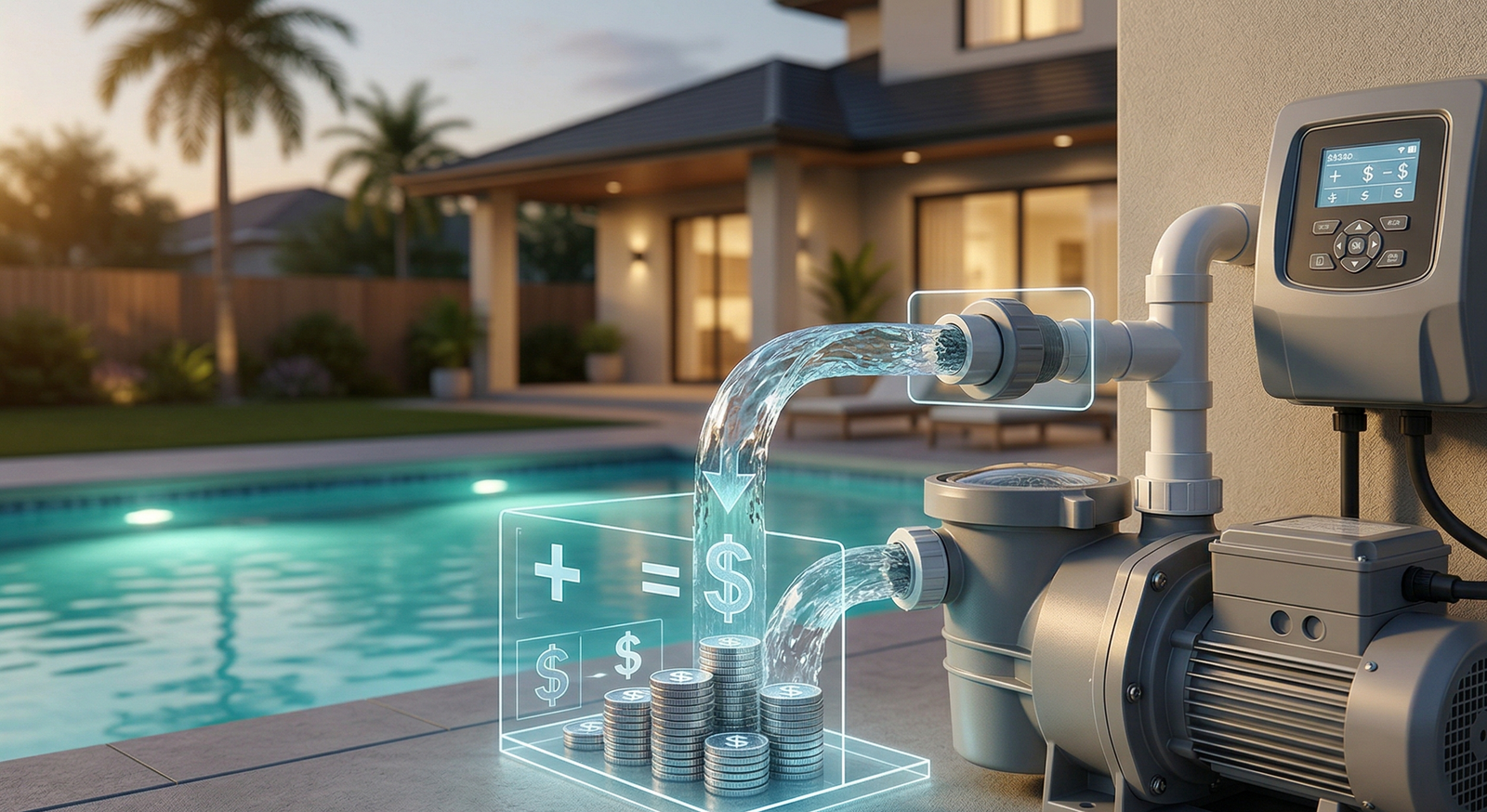
Your pool pump is probably the second most expensive appliance in your home to run. In some Florida homes, it is the first. And most pool owners have no idea how much electricity it actually uses because the cost is buried inside their monthly FPL bill with everything else.
Let’s fix that. This post breaks down exactly how much energy your pool pump consumes, what it costs you each month, and whether upgrading to a more efficient pump is actually worth the investment. No guessing. Just math.
How Much Electricity Does a Pool Pump Use?
The answer depends on three things: the type of pump, the horsepower, and how many hours per day it runs. Let’s walk through each.
Single-Speed Pumps
A single-speed pump runs at one speed: full power, all the time. It is the oldest and most common pump technology, and it is by far the least efficient.
A typical residential single-speed pool pump in Brevard County is 1 to 1.5 horsepower. At full speed, it draws approximately 1,500 to 2,200 watts depending on the motor size and age.
Most pool professionals recommend running your pump long enough to turn over the entire pool volume at least once per day. For a typical 15,000 gallon pool with a 1.5 HP single-speed pump flowing at roughly 60 gallons per minute, one full turnover takes about 4 to 5 hours. But many pool owners run their pump 8 to 12 hours per day based on older recommendations or because their timer is set to a longer cycle.
Here is what that costs using Florida Power and Light’s average residential rate of roughly $0.13 to $0.15 per kilowatt-hour.
A 1.5 HP single-speed pump drawing 2,000 watts and running 8 hours per day uses 16 kilowatt-hours (kWh) per day. Over a month, that is 480 kWh. At $0.14 per kWh, that is roughly $67 per month.
Running the same pump 10 hours per day: 600 kWh per month, roughly $84 per month.
Running it 12 hours per day: 720 kWh per month, roughly $101 per month.
Over a full year with no seasonal adjustment, that is $800 to $1,210 just for the pool pump.
In Florida, where pools run year-round, there is no off-season to bring that average down. You are paying that number every single month.
Two-Speed Pumps
Two-speed pumps offer a high speed and a low speed. The high speed is similar to a single-speed pump. The low speed runs at roughly half the RPM and uses significantly less power.
The key principle here is called the pump affinity law. It states that when you cut the speed of a pump motor in half, the energy consumption drops to roughly one-eighth. Not one-half. One-eighth. This is because energy use is proportional to the cube of the speed.
A two-speed pump running on low speed for most of the day and switching to high speed for a few hours uses dramatically less electricity than a single-speed pump running at full power all day.
Typical energy consumption for a two-speed pump: 400 to 800 kWh per month depending on the high/low split. At $0.14 per kWh, that is $56 to $112 per month. Annual cost: $670 to $1,340.
The savings over a single-speed pump are moderate but real, typically 20% to 40%.
Variable-Speed Pumps
Variable-speed pumps are the most efficient option available. They use a permanent magnet motor (similar to what electric cars use) that can run at any speed from about 600 RPM to 3,450 RPM. You program them to run at the lowest speed that still provides adequate filtration and circulation.
For most residential pools in Brevard County, a variable-speed pump can handle daily filtration at 1,200 to 1,800 RPM. At those low speeds, the pump draws only 200 to 500 watts compared to 1,500 to 2,200 watts for a single-speed pump at full power.
Typical energy consumption for a variable-speed pump: 150 to 400 kWh per month. At $0.14 per kWh, that is $21 to $56 per month. Annual cost: $250 to $670.
Compared to a single-speed pump, a variable-speed pump saves $500 to $900 per year in electricity costs. Over the 8 to 12 year lifespan of a pump, that is $4,000 to $10,800 in total energy savings.
Putting It in Context: Your Pump vs. Other Appliances
To understand how significant your pool pump’s energy use is, let’s compare it to other common household appliances.
A central air conditioning system in a Brevard County home typically uses 1,000 to 2,500 kWh per month during summer. That is the biggest energy user in most Florida homes, no question. But your AC usage drops significantly in the cooler months from November through March.
Your pool pump uses 480 to 720 kWh per month (single-speed) every month of the year with no seasonal break.
An electric water heater uses roughly 300 to 500 kWh per month. A refrigerator uses 100 to 150 kWh per month. A clothes dryer uses 60 to 100 kWh per month. A dishwasher uses 30 to 50 kWh per month.
When you average everything over a full 12-month period, a single-speed pool pump often ranks as the number one or number two electricity consumer in a Florida home. During the mild winter months when AC usage drops, the pool pump easily takes the top spot.
The Florida Variable-Speed Pump Law
Florida recognized the energy waste problem and took action. The Florida Building Code now requires variable-speed pumps for all new pool construction and for any pump replacement on an existing pool.
If your single-speed pump fails and you need a replacement, you are required by law to install a variable-speed pump. You cannot legally replace a single-speed pump with another single-speed pump.
Some pool owners see this as an annoying regulation. But when you look at the energy savings, the law is actually saving you money over time. The higher upfront cost of a variable-speed pump is offset by lower electricity bills within 2 to 3 years.
The Real Cost of a Variable-Speed Pump Upgrade
If your current single-speed pump is still running, you have a choice: wait until it fails and replace it then, or upgrade proactively to start saving on electricity now.
Here are the typical costs for a variable-speed pump upgrade in Brevard County.
The pump unit itself ranges from $800 to $1,800 depending on the brand and horsepower. Popular brands include Pentair IntelliFlo, Hayward Super Pump VS, and Jandy VS FloPro. Installation labor typically runs $200 to $500 depending on the complexity of the plumbing and electrical work. If your existing electrical setup needs modifications (for example, upgrading from a standard outlet to a dedicated circuit), that can add $100 to $300.
Total installed cost: $1,000 to $2,500 for most residential pools in Brevard County.
With annual energy savings of $500 to $900 compared to a single-speed pump, the payback period is typically 1.5 to 3 years. After that, the savings are pure profit on your electricity bill for the remaining 6 to 10 years of the pump’s life.
Beyond Energy: Other Benefits of Variable-Speed Pumps
Lower electricity bills are the headline benefit, but variable-speed pumps offer several other advantages that are worth noting.
Quieter operation. A single-speed pump running at full power is loud. Most homeowners can hear it clearly from inside the house or across the yard. A variable-speed pump running at low speed is barely audible. If your pump equipment is near a bedroom window, a patio, or a neighbor’s property line, the noise reduction alone is a meaningful quality-of-life improvement.
Longer equipment life. Running a pump at lower speeds puts less stress on the motor, bearings, seals, and plumbing. Variable-speed pumps typically last 8 to 12 years, and some last longer because the reduced operating stress means less wear and tear.
Better filtration. This sounds counterintuitive, but running your pump at a lower speed for more hours actually provides better filtration than running at high speed for fewer hours. Lower flow rates give the filter more time to trap particles. The water moves through the filter media more slowly, which means finer particles get caught instead of pushed through.
Reduced chemical usage. Better filtration means cleaner water, which means your sanitizer (chlorine) works more efficiently. Some pool owners report a modest reduction in chemical costs after switching to a variable-speed pump, though the savings are small compared to the electricity savings.
How to Optimize Your Current Pump’s Efficiency
If you are not ready to upgrade yet, there are a few ways to reduce your current pump’s energy consumption.
Reduce run time. Many pool owners run their pump longer than necessary. For a properly maintained pool in Brevard County, 6 to 8 hours per day is usually sufficient for a single-speed pump. If your pool service company is maintaining proper chemical balance and the pool is staying clear, try reducing your run time by one hour and monitoring the results. If the water stays clear after a week, try reducing by another hour.
Run during off-peak hours. FPL offers time-of-use rate plans where electricity costs less during off-peak hours (typically overnight). Running your pump from midnight to 8 AM instead of during the afternoon can save 10% to 20% on the pump’s electricity cost.
Keep your filter clean. A dirty filter restricts flow, which makes the pump work harder and draw more power. Regular filter cleaning keeps the system operating efficiently.
Check for air leaks. Air leaks in the suction side of the plumbing (between the skimmer and the pump) make the pump work harder to maintain prime. If you see air bubbles in your pump basket or a stream of bubbles returning to the pool through the return jets, you likely have a suction leak that is wasting energy.
Make sure the pump is properly sized. An oversized pump moves more water than necessary and wastes energy doing it. If your pump was installed without a proper sizing calculation, it may be larger than your pool needs. Your pool service tech can help evaluate whether your pump is the right size.
The Math That Matters
Here is the simplest way to think about it. A single-speed pump costs roughly $70 to $100 per month to run in Florida. A variable-speed pump costs roughly $20 to $55 per month. The difference is $45 to $80 per month, or $540 to $960 per year.
Over 10 years, that is $5,400 to $9,600 in electricity savings from a single equipment change that costs $1,000 to $2,500 to make.
No other single upgrade to your pool system offers a return on investment that is even close.
If you want to know exactly how much electricity your specific pump is using, ask your pool service technician to check the pump’s wattage draw and calculate your monthly cost based on your run time and electricity rate. Or if you are thinking about an upgrade and want a recommendation on the right variable-speed pump for your pool, contact Happy Pool and Spa for a free consultation. We help pool owners across Brevard County, from Satellite Beach to Rockledge to Melbourne, make smart decisions about their pool equipment.